





 :
:
[Sponsored content] Dharma’s centralised operations platform helps to unify workflows so serviced apartment operators can scale extended stay demand.
The serviced apartment and extended-stay sector has experienced a rise in demand, driven by travellers seeking more space, longer stays, and flexible accommodation. Remote work, relocation programs, long-term projects, and changing travel habits have all pushed guests toward stays measured in weeks or months instead of nights. But higher occupancy and longer-term guests also bring operational complexity that traditional tools weren’t built for.
Operators must balance hotel-style service with residential-level upkeep, and that combination exposes every weakness in a fragmented operations setup. Hotels typically rely on centralised systems and established procedures, while residential properties depend on long-term maintenance routines. Extended stay requires both, and the friction becomes clear the moment teams don’t have the right tools in place.
Where extended-stay operations break down
Serviced apartment teams often manage:
- High asset wear from long-stay guests
- Mid-stay cleans and periodic maintenance
- Detailed check-in/out inspections
- Guest communication across multiple channels
- Coordination between housekeeping, maintenance, and the front office
On paper, these workflows feel manageable. In practice, they intersect constantly and depend heavily on timing, coordination, and clear communication. A missed mid-stay clean isn’t just an inconvenience, it sets off a chain reaction. Guests may report cleanliness issues, cleaners rush to catch up, maintenance inspections get postponed, and managers must piece together what went wrong.
Without a centralised system, these workflows become harder to track and easy to overlook. Teams rely on manual processes that may have worked with fewer units but now create friction at scale. Sticky notes, chat apps, and informal reminders can’t support the demands of extended-stay operations. Once operators reach 20, 50, or 100 units, even minor oversights show up as bigger operational gaps.
For example, long-stay guests often request small adjustments during their stay, like extra linens, a change in cleaning frequency, a minor repair, or help with appliances. When these requests flow through multiple channels, staff lose precious time tracking down the details. The guest may tell the front desk, send a message through a booking platform, and mention it again during a routine check-in call. Without a unified workflow, teams either duplicate tasks or miss them entirely.
The cost of fragmentation in serviced apartments
Extended-stay operators feel the impact quickly:
- Missed work orders interrupt long stays
- Delayed maintenance increases asset costs
- Staff rely on outdated notes or inconsistent procedures
- Managers lose visibility across multiple buildings or markets
- Guest satisfaction drops from communication delays.
Unlike short-term rentals, where guests stay only a few nights, extended-stay guests have a much deeper connection to the property. They pay attention to how quickly issues are resolved, whether requests are handled consistently, and how well the team maintains the apartment. If operations aren’t aligned, these guests will feel it, sometimes within the first week.
Long-term stays also put more pressure on the asset itself. Appliances get more use, furniture wears faster, and smaller issues become large ones if not addressed in time. Fragmentation slows down the operator’s ability to respond, increasing maintenance costs and creating unnecessary turnover challenges. A simple unresolved issue, like a loose cabinet hinge or a malfunctioning AC filter, becomes more expensive the longer it goes unnoticed.
In a segment where repeat stays and long-term guests drive revenue, consistency is crucial and matters more than ever. Word-of-mouth, corporate partnerships, and relocation agencies value reliability above all else. If an operator can’t maintain consistent operations across multiple units or locations, they risk losing out on long-term contracts and business accounts that depend on predictable service quality.
Why centralised operations are becoming essential
A unified platform gives extended-stay teams a single ecosystem where everything is connected:
- Work orders
- Housekeeping coordination
- Guest messaging
- Internal communication
- Multichannel reporting
- Knowledge access for staff
Centralisation isn’t just about convenience, it’s about creating an operational rhythm that scales. When communication, tasks, and data live in separate tools, teams waste time searching, confirming, and rechecking information instead of simply completing the work. But when everything flows through one system, teams can anticipate issues, stay organised, and deliver a consistently high-quality experience.
This reduces repetitive work, prevents issues from getting overlooked, and supports higher operational standards across multiple properties. Operators can finally rely on a single source of truth instead of stitching together temporary solutions. And when teams use the same workflows and the same language across the portfolio, training becomes faster and performance becomes more predictable.
How Dharma’s operations platform fits the serviced apartment model
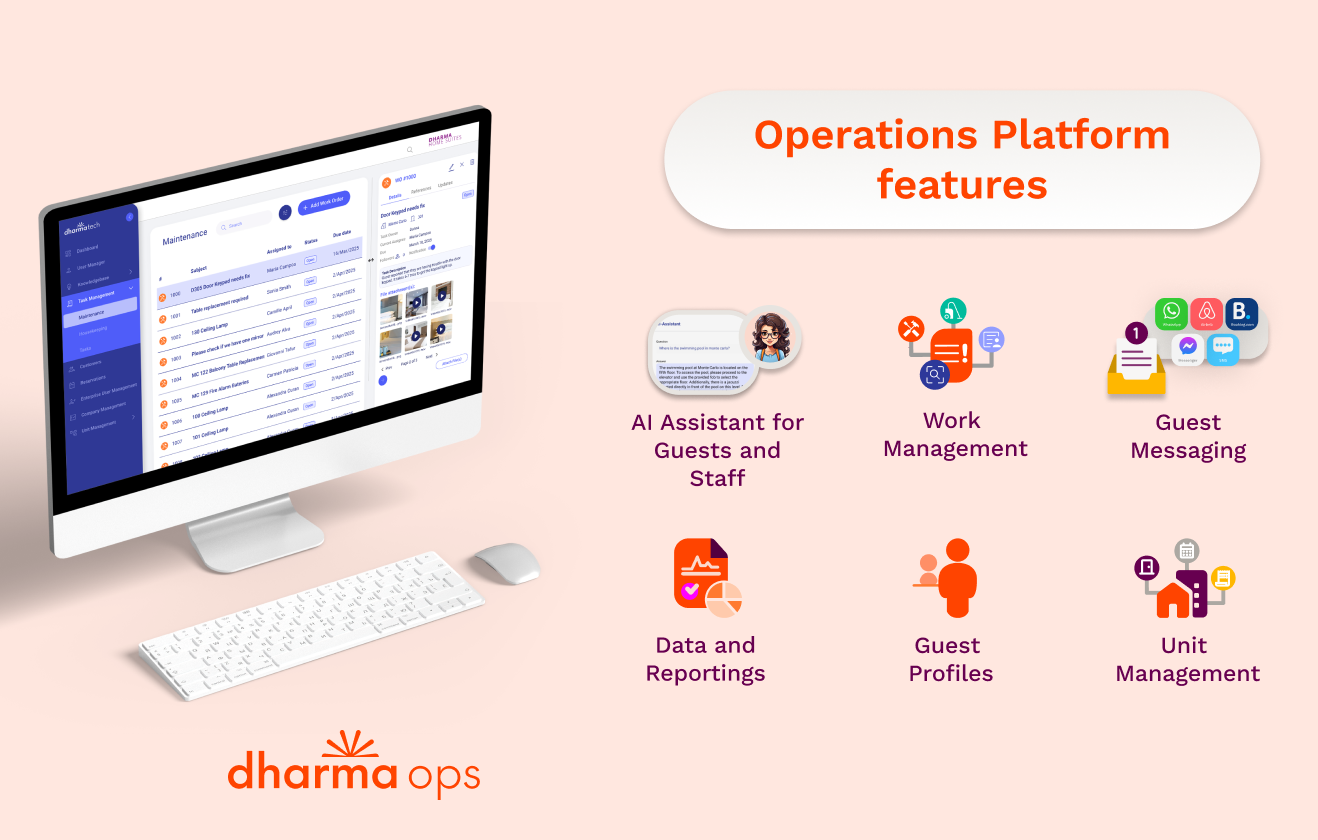
Dharma’s Operations Platform (OPS) was built with multi-unit hospitality in mind, making it a strong fit for serviced apartments, corporate housing, and aparthotels. Extended stay requires structure, clarity, and visibility, exactly what Dharma OPS was designed to deliver.
• Create smart, trackable work orders
Maintenance and housekeeping tasks become structured workflows with status updates, priorities, and timestamps, ideal for managing mid-stay service cycles. Teams don’t rely on memory or group chats. Everything flows into a clear work order pipeline where nothing gets lost.
• Centralise guest messaging
Operators handling multiple communication channels can respond quickly and consistently through a single hub. Whether a guest messages through email, WhatsApp, Airbnb, or a booking platform, replies stay organised and accessible for the team. This prevents miscommunication and reduces response times, two of the biggest challenges in extended stay.
• Improve team efficiency with AI
Staff-facing AI reduces the time spent searching for procedures, while guest-facing AI provides instant, accurate answers to common questions. This is particularly valuable for long-stay guests who need ongoing support, not just pre-arrival communication. Teams get the answers they need in seconds, even when managers aren’t available.
• Gain visibility across multiple properties
Reporting helps operators monitor work order trends, staff performance, and guest communication metrics across their entire portfolio. With extended stay, even minor gaps in performance become more noticeable, and visibility is key to catching early signs of operational strain.
Why this matters for extended stay
Long-stay guests judge the experience differently. They notice delays, inconsistencies, and operational gaps over weeks, not hours. A single missed clean or delayed repair can impact their perception of the entire stay. Strong operations are the foundation of the guest experience.
Extended-stay operators who want to scale need a workflow that supports consistency, reduces manual work, and gives teams real-time clarity. A unified operations backbone, like Dharma OPS, helps extended-stay brands maintain efficiency, consistency, and service quality even as portfolios grow.
Learn more about Dharma in the video below.